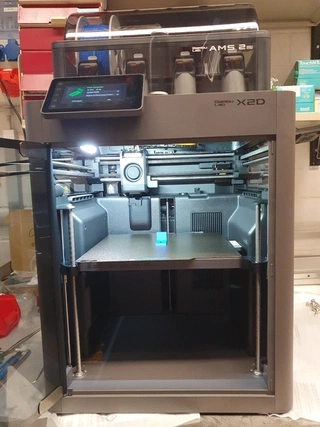
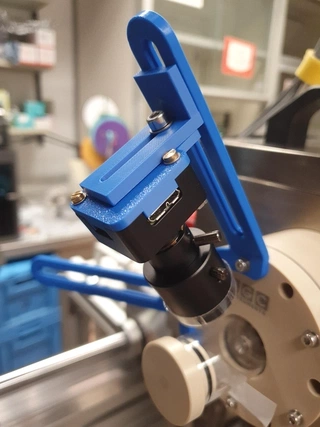
A 3D printer in the lab
The big boss said OK: the laboratory is now equipped with a Bambu Lab X2D 3D printer (€850 with the multi-material AMS 2). Getting started is quick, dual nozzle, wide range of compatible materials.
There remains the production of the parts; I am not a big fan of CAD software with complex features and an interface that is often hard to get into, but I found a working environment I like, with AI: the PI agent, an MCP plugin for FreeCAD or Blender, and the GPT 5.6 Luna model, which turns a simple description of my parts in natural language, turned into a 3D model in a few iterations. The main drawback remains the slowness of the iterations, but the revolution is underway.
GPT excels at visual recognition — essential here — and Sol brings no decisive gain over Luna. The models I love for coding (GLM, Deepseek) are weaker at vision: multimodal GPT models are, in my opinion, the most performant on these tasks.
The essence of this approach now lies in the description: expressing a 3D part in words alone requires precise technical vocabulary. Wording a mechanical assembly unambiguously is actually more demanding than sketching a diagram on paper to share with a colleague.
Experience shows that the limits encountered do not come from the model itself, but from the agent’s understanding of the request. A simple practice improves results noticeably: before executing, ask the agent to confirm that the instructions are clear and to recap what it is about to do. Once agreement is reached, execution, although sometimes slow (including for small adjustments one might rather do in the GUI), generally proves remarkably reliable.
Just do it.